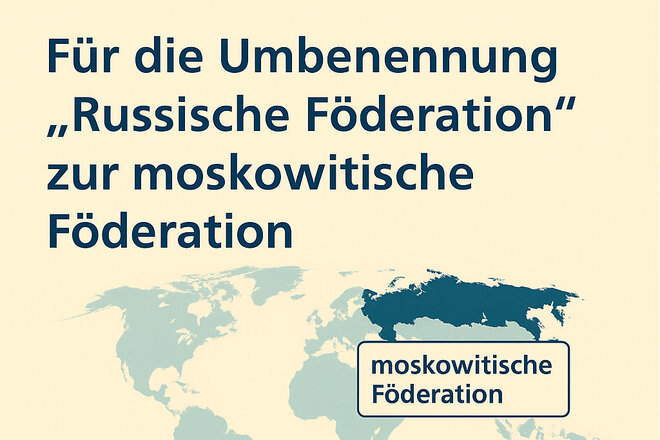
33 Podpisy
Zbiórka zakończona
Petycja jest adresowana do: Institutionen der EU, Nationalstaatliche Institutionen, Bevölkerung (allgemeiner Sprachgebrauch)
Our Demands:
We call on political, educational, and cultural institutions in Europe to:
- Critically reflect on the terms “Russia” and “Russian Federation” in public, academic, and diplomatic contexts — especially regarding their historical roots and political misuse.
- Introduce and promote the use of "Muscovite Federation" (or similar historically appropriate alternatives) in settings where historical precision and cultural distinction are necessary — e.g., in schoolbooks, universities, maps, exhibitions, and media reporting7.
- Support independent historical research and education about Kyivan Rus, Ukraine, and Eastern Europe, beyond Russian-centric narratives8.
- Demonstrate solidarity with Ukraine by using terminology that reflects historical reality rather than imperial claims.
Our Intention:
This petition is not directed against the Russian people, but against a state identity based on misappropriated history. Language is political. By using accurate and non-imperial terminology such as "Muscovite Federation", Europe can help decolonize its view of Eastern Europe, encourage historical truth, and resist the symbolic foundations of modern-day authoritarianism9.
Uzasadnienie
The current official designation of the state with its seat in Moscow — the "Russian Federation" — is rooted in a historical construct deliberately shaped in the 18th century by the Tsardom of Russia. This construct is based on the appropriation of the name and heritage of the medieval Kyivan Rus, an early East Slavic polity centered in what is today Kyiv, Ukraine. Referring to the modern state as "Russia" is therefore historically misleading and politically problematic — especially in light of the Russian war of aggression against Ukraine and the ideological narratives underpinning it.
📚 Historical Background:
The Kyivan Rus existed between the 9th and 13th centuries and is considered one of the earliest East Slavic states. Its political, cultural, and religious heart was located in present-day Ukraine. After the Mongol invasion in the 13th century, the Rus' territories fragmented, and various principalities developed independently — including the Grand Duchy of Moscow, which emerged only centuries later1.
Until the early 18th century, European sources generally referred to the Moscow-centered state as "Muscovy"2. In 1721, Tsar Peter I officially renamed the Tsardom into the Russian Empire ("Imperija Rossijskaja"), aiming to present his state as the direct successor to the Kyivan Rus. This renaming was a strategic act of imperial historical engineering3.
The modern name "Russian Federation" continues this tradition and symbolically appropriates a cultural and historical legacy that is primarily rooted in Ukrainian history. This linguistic identity confusion is being exploited in contemporary Russian foreign policy to legitimize territorial claims and assert cultural superiority4.
Political and Cultural Consequences:
The dual use of the term “Rus” and “Russia” leads to:
- the undermining of Ukraine’s cultural and historical sovereignty,
- the reinforcement of the myth of a "single Russian nation",
- the unintentional reproduction of Russian imperial narratives in European educational and political discourse5.
This is not just a historical concern, but has tangible political implications: Russia’s leadership invokes these myths to justify aggression against Ukraine, framing it as part of a “shared historical homeland”6.
Footnotes
- Franklin, S., & Shepard, J. (1996). The Emergence of Rus 750–1200. Longman. ↩
- Poe, M. (2003). The Russian Elite in the Seventeenth Century. Ashgate. ↩
- Hosking, G. (2001). Russia and the Russians: A History. Belknap Press. ↩
- Snyder, T. (2010). Bloodlands: Europe Between Hitler and Stalin. Basic Books. ↩
- Plokhy, S. (2015). The Gates of Europe: A History of Ukraine. Basic Books. ↩
- Umland, A. (2022). “Ideological Roots of Russian Neo-Imperialism.” Journal of Post-Soviet Politics. ↩
- European Parliament (2022). Resolution on the consequences of Russia’s war of aggression against Ukraine. ↩
- Wilson, A. (2015). Ukraine Crisis: What It Means for the West. Yale University Press. ↩
- Leggewie, C. (2014). Europa zuerst. Eine Unabhängigkeitserklärung. Rowohlt. ↩
Dziękujemy za wsparcie, Mag. Peter Petrus, Bad Vöslau
Pytanie do inicjatora
Informacje na temat petycji
Petycja rozpoczęta:
23.04.2025
Kolekcja kończy się:
22.10.2025
Region:
Unia Europejska
Kategoria:
Polityka zagraniczna
Statystyki petycji
Kibice według kraju
| Państwo | numer | kworum (?) |
|---|---|---|
| Česko | 3 | 0,02% |
| Canada | 2 | |
| Slovensko | 2 | 0,02% |
| Україна | 2 |
Dystrybucja podpisów
Może Cię również zainteresować

691
Podpisy
12 dni
pozostały
Nauki
In A Plea for All Humankind: Please Sign This Petition for Excellence and Precision in Science
1 223
Podpisy
7 dni
pozostały