
67 podpisy
50 000 pro místo určení sbírky
Petice je adresována: BMDS (BM Dr. Karsten Wildberger), BBFSFJ (BMin Karin Prien), BFTR (BMin Dorothee Bär), Ausschuss für Digitales und Staatsmodernisierung des Bundestags, EU-Kommission, Europ. Parlament, Exekutiv-Vizepräsident(in) für Digitales der Europ. Kommission
Like water or electricity, web search is an essential public service. Web search engines determine what information we find and what remains hidden. They shape our knowledge, our opinions, our economy and our democratic participation. Yet today, the web search ecosystem is controlled by a few tech giants in the USA, Russia and China who put profit before people.
We call on politicians to recognise web search as essential public infrastructure and to create conditions that ensure it serves democracy – and the interests of the many, not just the few.
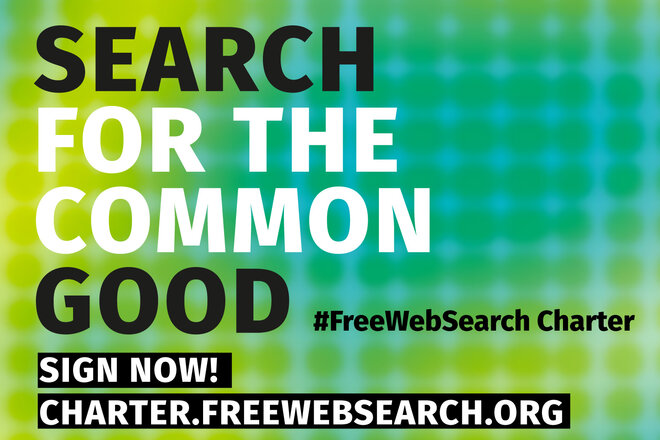
Through the #FreeWebSearch Charter, we are calling for fundamental reform of web search, setting out 10 concrete principles:
- Guarantee Transparency and Explainability.
- Foster competition and independent infrastructure.
- Strengthen privacy and enable search without tracking and profiling.
- Give users, creators and advertisers more control.
- Secure equal access and non-discrimination.
- Support information diversity and multiple perspectives.
- Take responsibility for environmental and social impact.
- Safeguard integrity and protect against disinformation.
- Build search competences and critical awareness
- Enforce democratic control and binding rules across borders.
Web search must serve the common good. We are committed to a web search infrastructure that serves society and respects human rights: one that is transparent and open, and that reflects the diversity of the internet.
Web search belongs to all of us. Let's reclaim it together!
Further information:
https://charter.freewebsearch.org
Odůvodnění
‘Access to information is a human right.’
Search engines hold the key to information, knowledge, education, commerce, and public debate on the internet. As critical infrastructure, they have a big effect on what information people can see online and what stays hidden. They affect how we find information, the opinions we form, and how we take part in discussions about society.
Web search is broken. Just a few big companies from the USA, Russia and China control web search. They decide what billions of people can find online. They collect huge amounts of personal personal data about what we search for and how we behave online. This is bad for free speech, society, and democracy.
This threatens our democratic society. We live in times of increasing disinformation, political division, and international tensions, and with more and more power being held by individual companies. We need to protect diversity of opinion, social cohesion, and democratic participation.
We can still change this – but we need to act now. We can still reshape how information flows in our society. Without intervention, corporate interests of a few will continue to override public good in determining what information people see.
Current developments highlight the urgency of the situation: A US court confirmed Google has a monopoly but barely punished them. The US threatens Europe for trying to regulate big tech companies. New AI search tools are creating the same monopoly problems all over again.
The main problems are: • Too few companies control search • We don't know how search results are generated • Extensive data collection without meaningful user control • We get trapped in ‘filter bubbles’ that hide different views • No one holds these companies accountable.
This petition demands web search that serve everyone – open, diverse, private, and answerable to the public. Together, we can make sure this essential service works for all of us, not just powerful companies.
Děkujeme za vaši podporu, Open Search Foundation e. V., Starnberg
Informace o petici
Petice byla zahájena:
28. 09. 2025
Sbírka končí:
27. 09. 2026
Kraj :
Evropská unie
kategorie :
Internet
Proč lidé podepisují
Nástroje pro šíření petice.
Máte svůj vlastní web, blog nebo celý webový portál? Staňte se obhájcem a multiplikátorem této petice. Máme bannery, widgety a API (rozhraní), které lze vložit na vaše stránky. K nástrojům
petice kurs
Příznivci podle země
| země | číslo | kvorum (?) |
|---|---|---|
| Deutschland | 46 | 0,06% |
| Nederland | 3 | 0,02% |
| Österreich | 2 | 0,01% |
| Danmark | 2 | 0,02% |
Distribuce podpisů

To by vás také mohlo zajímat

691
podpisy
19 dní
zbývající
6
podpisy
1 den
zbývající
I strongly believe it is the foundation for open science, open scholarship, and citizen science