342 signatures
Collecte terminée
Pétition adressée à : European Commission (DG Competition and DG CONNECT), European Parliament Committee on Internal Market and Consumer Protection (IMCO), Member State Competition Authorities (via European Competition Network)
The European Commission must enforce existing Digital Markets Act provisions and establish mandatory AI interoperability standards for all consumer hardware sold in the EU.
Specific demands:
- Equal API Access: Third-party AI services must have the same hardware and operating system access as pre-installed AI (NPU, sensors, system functions)
- True Uninstallation Rights: Users must be able to completely remove pre-installed AI without losing device functionality
- Revenue Transparency: Hardware manufacturers must publicly disclose all AI bundling agreements and revenue-sharing arrangements
- Data Portability: Users must be able to export their complete AI interaction history to competing services
- DMA Enforcement: Immediate investigation of Apple, Google, Samsung, and Microsoft for potential Article 6(3), 6(5), and 6(7) violations
Implementation: Through enforceable technical standards under the Digital Markets Act and competition law proceedings against non-compliant gatekeepers.
Raison
The AI bundling practices currently deployed violate EU competition law and consumer rights.
Court-documented evidence from US antitrust proceedings (April-September 2025) proves:
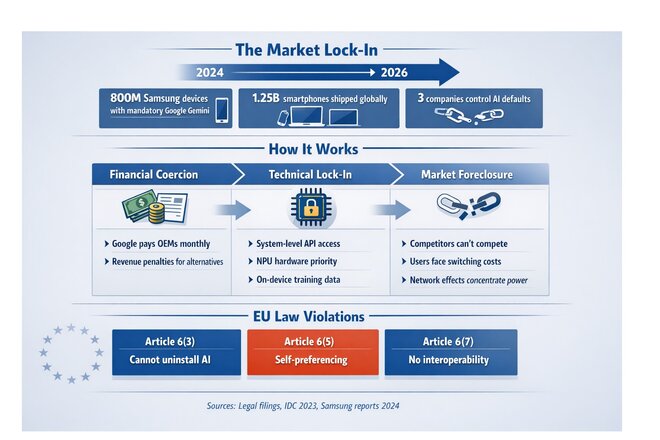
- Google pays Samsung monthly to pre-install Gemini AI and financially penalizes manufacturers who don't meet "placement obligations" (Source: US DOJ v. Google, MediaNama Sept 2025)
- Google contractually blocked Motorola from offering Perplexity AI as default despite manufacturer preference (Source: Bloomberg Law, April 23, 2025)
- Samsung will deploy mandatory Google Gemini on 800 million devices in 2026 (Source: Reuters, Jan 5, 2026)
- Apple is rebuilding Siri on Google Gemini infrastructure for spring 2026 launch (Source: Bloomberg/Mashable, Jan 2026)
This affects 1.25 billion smartphones shipped annually — nearly every consumer device in the EU market.
Why action is needed now:
The App Store monopoly took 10 years to regulate. By the time enforcement came, architectural lock-in was irreversible. AI bundling creates deeper lock-in because it controls the inference layer — how users access information, communicate, and make decisions.
When one AI controls defaults on a billion devices:
- Competing AI cannot access comparable training data
- Users face asymmetric switching costs
- Developers optimize for dominant platform
- Network effects concentrate market power
The DMA already prohibits this conduct. Gatekeepers must allow uninstallation (Art 6(3)), not self-preference (Art 6(5)), and provide effective interoperability (Art 6(7)). Current AI bundling violates all three provisions.
Sources:
- US DOJ antitrust filings: https://www.justice.gov/atr/media/1402141/dl
- MediaNama court analysis: https://www.medianama.com/2025/09/223-googles-oem-agreements/
- Bloomberg Law testimony: https://news.bloomberglaw.com/ip-law/google-blocked-motorola-use-of-perplexity-ai-witness-testifies
- DMA text: https://digital-markets-act.ec.europa.eu/index_en
Merci infiniment pour votre soutien, Erich Francois Hugo, Järfälla
Question à l'initiateur
Pétition de partage
détails de la pétition
Pétition lancée:
07/01/2026
Fin de la collecte:
06/07/2026
Région:
Union européenne
Catégorie:
Protection des consommateurs
Pétition de partage
Statistiques de pétition
Soutiens par pays
| Pays | Nombre | quorum (?) |
|---|---|---|
| Deutschland | 79 | 0,11% |
| Nederland | 31 | 0,16% |
| Polska | 21 | 0,05% |
| Österreich | 19 | 0,13% |
Distribution des signatures