Choix du sujet
Du 8 au 30 juin 2026 , les sujets pourront être soumis au vote en signant les pétitions suivantes. La pétition ayant recueilli le plus de signatures sera mise aux voix.
Inscription
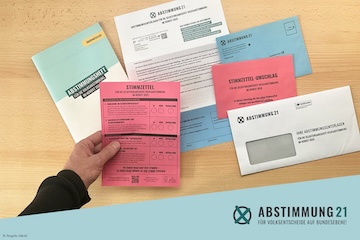
Vous pouvez vous inscrire pour voter en ligne de manière sécurisée et secrète jusqu'à la mi-septembre. Vous pouvez également voter par correspondance. Les bulletins de vote peuvent être commandés par courrier jusqu'au 9 août 2026.
Vote national
Le vote se déroule en ligne ou par courrier de septembre à octobre. Les résultats seront annoncés le 30 octobre.
CHOIX DU SUJET
Jusqu'en juin, les sujets pouvaient être soumis au vote sur openPetition et sur notre organisation sœur Abstimmung21 . Le processus de sélection a pris en compte la diversité thématique, l'actualité, la faisabilité, le débat et les différents points de vue politiques. Les propositions de sujets ayant recueilli le plus de soutien seront soumises au vote. Le référendum sur ces quatre sujets aura lieu en 2026.
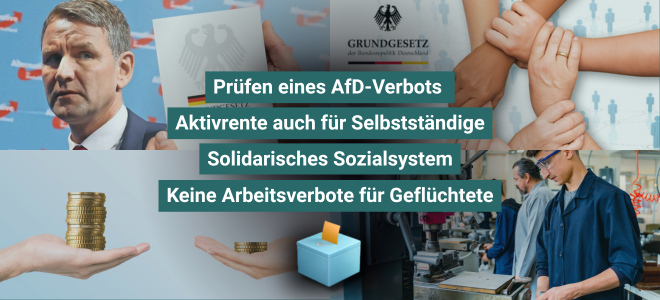
- Examen d'une interdiction visant l'AfD
- Régime de retraite actif également pour les travailleurs indépendants
- Système social fondé sur la solidarité
- Supprimer les interdictions de travail pour les réfugiés


Inscrivez-vous pour voter en ligne
Pour pouvoir voter en ligne, vous devez d'abord vérifier votre compte sur openPetition .
Seule cette étape est actuellement activée et peut être effectuée par vous.
Une fois le vote sur le sujet terminé, les documents électoraux peuvent être commandés en ligne jusqu'à la mi-octobre et sous forme analogique par courrier jusqu'au début août.
Nous vous informerons le moment venu.
FAQ sur le vote
Qui peut participer au référendum de cette année ?
Bien que nos modalités de vote soient calquées sur celles des élections du Bundestag allemand, nous souhaitons également permettre aux personnes résidant en Allemagne mais ne possédant pas la nationalité allemande de participer. Les personnes de nationalité allemande doivent au préalable vérifier leur compte sur openPetition à l'aide de leur carte d'identité électronique ou d'un code PIN postal. Les personnes ne possédant pas la nationalité allemande doivent également vérifier leur compte au préalable, mais uniquement par envoi d'un code PIN postal.
Comment les sujets du vote de cette année ont-ils été déterminés ?
Notre organisation sœur, ABSTIMMUNG21 a permis au public de proposer des sujets au printemps 2026 – et cette initiative a rencontré un vif succès : 396 propositions ont été soumises et plus de 200 000 votes ont été enregistrés. Les trois sujets ayant recueilli le plus de signatures seront soumis au référendum de l’automne 2026.
- Examen d'une interdiction visant l'AfD
- Régime de retraite actif également pour les travailleurs indépendants
- Système social fondé sur la solidarité
Un quatrième sujet a été déterminé en juin 2026 par openPetition à l'issue d'un processus de sélection basé sur une pétition. La pétition ayant recueilli le plus de signatures est devenue le sujet final soumis au vote : « Abolir les interdictions de travail pour les réfugiés ».
Lors du choix des sujets sur openPetition dix pétitions différentes étaient en concurrence. openPetition et ABSTIMMUNG21 eV étant toutes deux non partisanes, l'équilibre des sujets était primordial pour nous. Les critères de sélection étaient les suivants :
- Les sujets abordés dans leur ensemble couvrent-ils l'ensemble du spectre politique en termes d'opinions des différents groupes politiques (pluralité) ?
- Existe-t-il des sondages d'opinion publique actuels sur ce sujet (pertinence/urgence/volonté de la majorité/controverse) ?
- Existe-t-il des débats politiques sur ce sujet, même si une décision sur la question pourrait ne pas être prise d'ici l'automne (pertinence/urgence/faisabilité) ?
- Le Bundestag peut-il vraiment se prononcer sur cette question (faisabilité) ?
- Le quatrième thème (la pluralité) contribue-t-il à une plus grande diversité de sujets lors du vote de cette année ?
- Ce sujet est-il nouveau et ne faisait-il pas déjà partie de notre référendum auto-organisé (Nouvelle/Concurrence Équitable) ?
- S'agit-il d'un nouveau sujet, et n'y a-t-il pas déjà une pétition régulière à ce sujet sur openPetition (Nouvelle/Concurrence équitable) ?
La question de savoir si le Bundestag peut réellement trancher cette question, et si le sujet n'a pas été récemment abordé sous forme de référendums ou de pétitions en cours, a éliminé de nombreux sujets d'actualité.
Nous avons tout mis en œuvre pour que chacun·e puisse aborder au moins un sujet important. Contrairement à ABSTIMMUNG21 openPetition a choisi de ne pas proposer de sujets libres et a sélectionné dix thèmes controversés selon les critères mentionnés précédemment. Ce choix s'explique principalement par des contraintes de ressources et des échéances qui se chevauchent. Les thèmes retenus ne reflètent ni l'opinion d' ABSTIMMUNG21 ni openPetition ; ils visent uniquement à faciliter les débats sur les enjeux actuels.
openPetition est une organisation apprenante qui fait progresser cette expérience démocratique en collaboration avec ABSTIMMUNG21 . Si vous souhaitez nous faire part de vos commentaires, n'hésitez pas à nous envoyer un courriel à info@openpetition.net.
Comment garantir la sécurité du vote en ligne ?
Les élections et les votes démocratiques doivent pouvoir garantir un vote secret et égal – cela s’applique également s’ils ont lieu en ligne.
opn.vote garantit la confidentialité du vote grâce à un bulletin de vote numérique anonyme. Seul l'électeur y a accès, et personne d'autre. Ceci est rendu possible grâce à la clé de vote, générée uniquement sur l'appareil de l'électeur et connue de lui seul. Le bulletin de vote est signé cryptographiquement, ce qui le rend impossible à falsifier ou à dupliquer.
Les votes exprimés sont stockés publiquement et de manière immuable dans une blockchain décentralisée, la chaîne Gnosis. Comme les votes ne peuvent être attribués à aucun individu, leur confidentialité est préservée. Chacun peut vérifier son vote et, après l'élection, vérifier la validité de tous les votes et les compter lui-même. Aucune autorité centrale ne peut interférer dans le processus de vote ni falsifier les résultats.
Informations complémentaires sur la procédure de vote : https://www.openpetition.eu/pl/opn-vote
Pourquoi le processus de vote en ligne est-il divisé en créneaux horaires ?
Tout est question de sécurité : ce n'est qu'en maintenant des intervalles de temps entre les différentes étapes que nous pouvons garantir, grâce à des solutions techniques de pointe, que les exigences suivantes sont toujours satisfaites : générales, immédiates, gratuites, égales et confidentielles.
Le temps est particulièrement important pour le dernier principe du « secret » : le secret réside dans le fait que chaque personne peut exercer son droit de vote de telle manière qu’il ne soit pas possible de retracer comment elle a voté.
Je ne souhaite pas voter en ligne. Puis-je également participer au référendum par correspondance ?
Grâce à une technologie de pointe développée en interne, nous proposons le vote en ligne. Toutefois, afin que personne ne soit exclu, le vote par correspondance est également possible cette année. Vous pouvez commander votre matériel de vote jusqu'au 9 août 2026. Après cette date, seule l'inscription en ligne sera possible. Ceci garantit qu'aucune personne ne participe deux fois au référendum.
Pourquoi openPetition a-t-il créé un logiciel de vote en ligne sécurisé ?
Les logiciels de participation démocratique, comme les élections ou les référendums, ne devraient pas être l'apanage des grandes entreprises technologiques ni de l'État. Les outils démocratiques du futur sont entre les mains des citoyens.
Les référendums font-ils le jeu des populistes ?
C'est l'inverse qui est vrai : avec des règles équitables, la démocratie directe peut couper l'herbe sous le pied des populistes. Elle rend la politique plus transparente et donne plus d'influence à tous les citoyens, et pas seulement à ceux qui crient le plus fort. Grâce à une vérification indépendante des faits, à un format de débat et à une comparaison neutre des positions, nous garantissons que chacun est informé objectivement.
Du fait de leur durée – jusqu'à quatre ans au niveau fédéral – les référendums se prêtent moins aux réactions populistes impulsives. Ils suscitent néanmoins des débats intenses au sein de la société, ce qui contribue à briser les bulles informationnelles, à élargir et à approfondir la discussion, et donc à favoriser une approche plus objective.
En général, les référendums reflètent la société, mais ne sont pas responsables de son état. La société voit comment les choses évoluent. Il n'est pas toujours nécessaire de recourir à un référendum. L'effet préventif de la démocratie directe oblige les responsables politiques à prendre en compte les divers intérêts de la population. La démocratie directe agit également comme un exutoire. Elle peut dissiper le sentiment répandu de ne pas être entendu. En permettant à chacun de jouer un rôle créatif, la démocratie directe se concentre moins sur « ceux qui sont au sommet ». Si les occasions de lancer une initiative populaire sont nombreuses, il appartient à chacun d'entre nous de déterminer son sort.
Les résultats du référendum en Allemagne sont-ils juridiquement contraignants ?
Avec notre partenaire ABSTIMMUNG21 , nous nous appuyons sur l'article 20, alinéa 2, de la Loi fondamentale. Celui-ci stipule : « Tout pouvoir d'État émane du peuple. Il est exercé par le peuple lors d'élections et de référendums […] . »
Le vote national bénéficie donc déjà d'une certaine légitimité. Aucune loi d'application concrète ne garantit encore son caractère contraignant. C'est pourquoi nous organisons nous-mêmes le vote.
Néanmoins, le vote peut et doit non seulement être un signal pour l’instrument du référendum, mais aussi avoir un impact spécifique sur une question donnée.
Avec ABSTIMMUNG21 , nous nous efforçons de nous développer et d'encourager toujours plus de personnes à participer à cette expérience démocratique. Toutes nos actions sont financées par des dons.
Si de nombreuses personnes votent non seulement pour le Bundestag mais votent également sur une question via openPetition & ABSTIMMUNG21 , alors le Parlement reçoit un mandat clair pour agir.
La Suisse est-elle un modèle pour nous ?
La démocratie directe en Suisse est peut-être un modèle en principe, mais sur des points essentiels, elle n'est pas, et surtout, ne peut être transposée à l'identique en Allemagne. Contrairement à la Suisse, nous privilégions un modèle de démocratie directe à trois niveaux, aux niveaux étatique et fédéral : initiative populaire, pétition populaire et référendum. Après l'initiative, un contrôle de légalité est prévu (contrôle préventif des normes juridiques). La Cour constitutionnelle fédérale peut ainsi examiner la compatibilité d'un projet de loi avec la Loi fondamentale et le droit international et rejeter l'initiative si les droits fondamentaux et les droits des minorités sont violés. La pétition populaire et le référendum n'ont alors plus lieu d'être. C'est une différence essentielle avec la démocratie directe en Suisse.
Il n'existe pas de contrôle préalable exhaustif. La Suisse ne dispose pas non plus de sa propre Cour constitutionnelle. Les lois votées par le peuple ne peuvent être portées devant la Cour européenne des droits de l'homme qu'a posteriori, qui examine ensuite leur conformité à la Convention européenne des droits de l'homme.
Des changements extrêmes de la loi, tels que « l’introduction de la peine de mort », sont-ils possibles ?
Non. Nous nous inspirons du système de législation populaire à trois niveaux des Länder allemands et de la proposition de loi conjointe des organisations démocratiques Mehr Demokratie, OMNIBUS pour la démocratie directe et Democracy International. Ce système garantit la protection des droits fondamentaux et des droits des minorités. Ceci est garanti par le fait que tout projet de loi d'initiative populaire est examiné par la Cour constitutionnelle fédérale, à la demande du gouvernement ou du Parlement, afin de vérifier sa compatibilité avec la Loi fondamentale et le droit international – et peut être suspendu en cas de violation. Ce « contrôle préventif des normes » existe déjà dans les processus de démocratie directe de tous les Länder.
Le Brexit n’a-t-il pas montré que les référendums sont dangereux ?
Le Brexit n'est pas un exemple pertinent de démocratie directe en Allemagne. Initié par le gouvernement britannique, il a été détourné par les partis à des fins populistes. L'enquête manquait de modèle de vote clair et d'informations équilibrées. De plus, en Suisse, par exemple, il est courant que les traités internationaux soient soumis à un double vote : une fois au début des négociations et une fois à la fin, lorsque tous les détails de l'accord sont sur la table.
Jusqu'à présent, openPetition s'est principalement concentré sur les pétitions. Pourquoi maintenant les référendums ?
Notre société est confrontée – aujourd'hui et sera toujours – à de nombreux défis majeurs. Le dialogue avec le public est la meilleure façon de les résoudre ensemble. C'est pourquoi openPetition promeut principalement les pétitions. La démocratie directe offre à la société civile une nouvelle occasion de soumettre ses idées et ses concepts au vote. Il est peu probable que les citoyens se sentent soutenus à 100 % par un seul parti, mais au niveau fédéral, les élections sont le seul moyen de consulter directement les citoyens. Pourquoi la souveraineté du public n'est-elle reconnue que tous les quatre ans ? Les référendums contribuent à consolider les décisions politiques et à mettre en évidence les points à améliorer. Ils peuvent renforcer la confiance en soi et en la démocratie, et contribuer à lutter contre le désenchantement politique.
Depuis des années, l'introduction légale de référendums nationaux est bloquée. Pourtant, le besoin est réel, et des sondages représentatifs montrent régulièrement que plus des deux tiers de la population y sont systématiquement favorables. En permettant aux citoyens de voter sur des questions spécifiques et importantes, nous rendons le vote national tangible et concret. Nous démontrons qu'une plus grande démocratie est également possible au niveau fédéral !

Livret de vote
Avant de voter, l'information est donnée ! Pour que chacun soit informé de manière égale et puisse se forger sa propre opinion, des livrets de vote neutres, contenant des arguments pour et contre, sont préparés et mis à disposition de tous. Ce livret fait partie intégrante du processus de vote.

Chambres des parlements
Les parlements de maison sont des réunions où une question est débattue. Ils se tiennent là où se forgent les opinions : à la maison, lors de repas en famille, au cours de conversations entre amis ou connaissances dans un café, au pub du coin ou au parc. Avec les parlements de maison, nous souhaitons faire de l’échange d’opinions et des discussions une composante essentielle des référendums.

Vote national
Avec ABSTIMMUNG21, nous avons organisé le premier référendum national de l'histoire de la République fédérale d'Allemagne en 2021. Et nous ne nous arrêterons pas tant que les référendums nationaux ne seront pas une réalité. Alors, rejoignez-nous cette année !